How to Make a Felted Fleece Rug

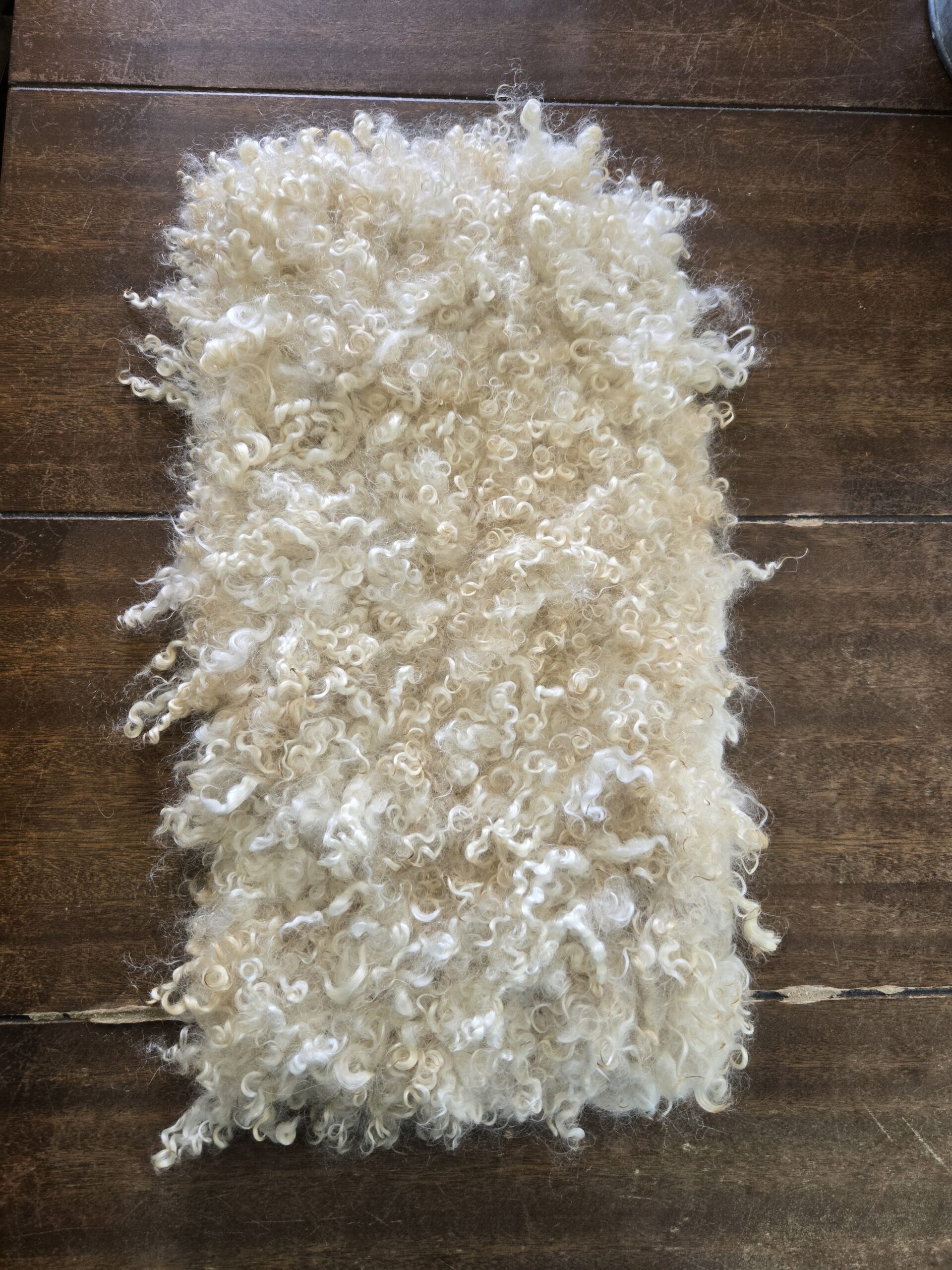
Use these steps to make a beautiful, cruelty-free, handmade rug with raw locks from a fiber animal. Materials, felting techniques, and tips for success will be covered in this tutorial. Enjoy the luxury of a felted fleece rug in your home!
This post contains affiliate links. As an Amazon Associate, I earn from qualifying purchases.
Making a felted fleece rug has been on my bucket list since I bought my first Angora goats. The locks of fiber from an Angora goat (called mohair) are so shiny and soft and I knew they would make the most beautiful and luxurious rug!
At first, I was intimidated by the idea of felting a rug with mohair locks because I didn’t want to mess up a bunch of beautiful fiber and waste it. So, I practiced my felting techniques and made smaller projects like felted soap, pin cushions, bowls, coasters, hot pads, and dryer balls. You can use the links provided to access these other tutorials if you are interested.
Then, I decided I was ready to take the plunge, so I made my first attempt at wet-felting a small mohair lock rug and documented it with lots of pictures and notes. It turned out so amazingly that I wanted to share my experience so you can make your own cruelty-free, handmade rug to enjoy in your home.
I have since made many more mohair rugs of various shapes and sizes. Use these directions and the video tutorial provided to give it a try yourself!
What is a Felted Fleece Rug?
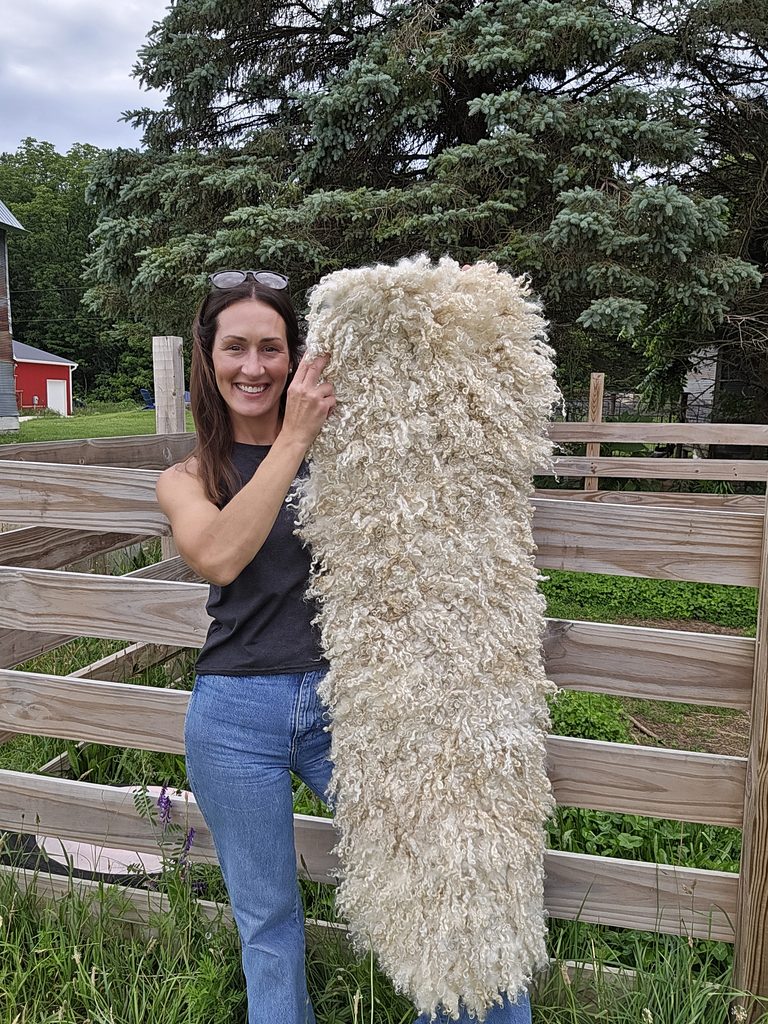
A felted fleece rug is a thick, plush rug made from natural animal fiber. Usually, these rugs are made from breeds that produce long staple length fibers like Teeswater sheep or Angora goats.
Felted fleece rugs highlight the beauty of intact lock structure and feature a fluffy or curly surface with a dense wool backing. The wool backing, which holds the locks in place, is often from a breed that produces a coarser, more durable, and easily felting fiber like Romney or Corriedale.
Felted fleece rugs make a beautiful accent for any living space. You can use them as a mat for your feet, under a coffee table, as a centerpiece, or a throw for your couch. Pets love using them as a cozy bed too!
Why a Felted Fleece Rug?
Because no hide is used, felted fleece rugs are a cruelty-free alternative to traditional, tanned sheep or goatskin rugs. These types of all-fiber rugs are also referred to as vegan or vegetarian rugs because no animals are harmed in the process of making them.
Not only are they no-kill, felted fleece rugs are a sustainable choice. Wool and mohair are a renewable resource, being constantly regrown by the sheep or goat that provided it.
In addition to being lovely, felted fleece rugs are also comfortable, durable, breathable, odor and stain resistant, and biodegradable.
For all these reasons, felted fleece rugs are a win for the animal-loving and eco-conscious as well as those that just revel in simple, natural beauty.
Techniques for Making a Felted Fleece Rug
A felted fleece rug can be created using wet felting techniques where raw locks from a shorn fleece are bound to a wool backing using water, soap, and manual agitation. The directions that follow will outline the steps necessary to wet-felt a fleece rug.
If any of the locks on the surface become matted or there is a sparse area on the rug’s surface, additional locks can be added through needle-felting. This process will also be discussed at the end of the tutorial.
Materials Needed for Making a Felted Fleece Rug
- Raw locks
- Wool roving
- Soap
- Bowl of water
- Bulb sprinkler
- Felting frame
- Felting mesh
- Textured mat
- Dowel
- Power Scour
Your wool or mohair locks do not need to be pre-scoured for this project. The raw locks will get washed in the process of making the rug.
I try to shear my Angora goats in one single sheet, which makes it easy to arrange the locks. You can use a portion of a fleece to make a small rug or an entire fleece, the amount of locks that you need depends on the size of the rug you want to make.
I use Romney wool roving to make the backing for my fleece rugs. Since roving is processed with the fibers aligned parallel to one another, it is easy to lay out in a cross-hatched pattern for wet-felting.
You can make the backing match or contrast with the surface of your rug; it is entirely up to you. I chose to use white wool roving so that the backing would blend in with my natural white and golden mohair locks.
Several layers of roving are required to make a thick, dense backing for your rug, so make sure you have plenty on hand.
I use my olive oil-based, handmade goat milk soap for wet felting. Click here for the recipe! It works great and doesn’t dry out my hands like commercial bar soap. You can use whatever is your favorite, liquid Dawn dish soap works well too.
You will use lots of water to complete this project and it gets pretty messy. I recommend making your rug outside on a nice day if you can. I use the hottest water I can stand because it speeds up the felting process.
A bulb sprinkler can help you wet your project down. If you don’t have one, just use your hands to transfer a little bit of water at a time from a bowl.
A frame or form can be made from various materials and will help you make your rug a certain shape. I made a rectangular felting frame with PVC pipe for small rugs. You might want to make yours round or mimic the shape of an animal hide rug. For round rugs, I use a kiddie pool as a felting form.
Using felting mesh will help you pre-felt your rug backing without moving the fibers around too much. It’s not completely necessary, but a nice safeguard if you are new to wet-felting.
I like to make rugs while standing up at my folding table that I cover with a textured yoga mat. The yoga mat provides just enough texture to agitate the surface of the rug while I am working on the backing with my hands.
You will need a dowel to wrap your rug around once you get to the rolling stage of felting. The dowel should be longer than your rug is wide.
Once the rug is finished it will be fairly clean from all the soap but will need a thorough rinsing. I give my rugs one final wash with Unicorn Power Scour to remove any residual dirt and oil. It works and smells great!
Video Tutorial for Making a Felted Fleece Rug
Linked here is a video tutorial where I used the same process outlined in this post to make a felted fleece rug in a kiddie pool. The result was a plush, round rug with a diameter of about 28 inches. Part 1 shows the wet-felting process in its entirety.
Part 2 shows how I put the finishing touches on my felted fleece rug by picking out vegetable matter, trimming the edges, and needle-felting additional locks onto the surface.
Directions for Making a Felted Fleece Rug
- Set up your work area and gather all the needed supplies
- Lay a textured yoga mat on top of your table and the felting frame on the yoga mat
- Arrange your locks inside the frame. The locks should be positioned so that the cut end is facing up. Pack them together so that the rug will have a nice dense pile. Take your time with this step!
- Now you are ready to begin layering roving over the cut lock ends. Make one layer going horizontally and make sure it completely covers all of the locks.
- Make a second layer of roving over the first. This layer should be going vertically.
- Make a third layer of roving over the second. This layer should be going horizontally again, creating a cross-hatched pattern that should felt readily.
- Make a fourth layer going vertically if you desire.
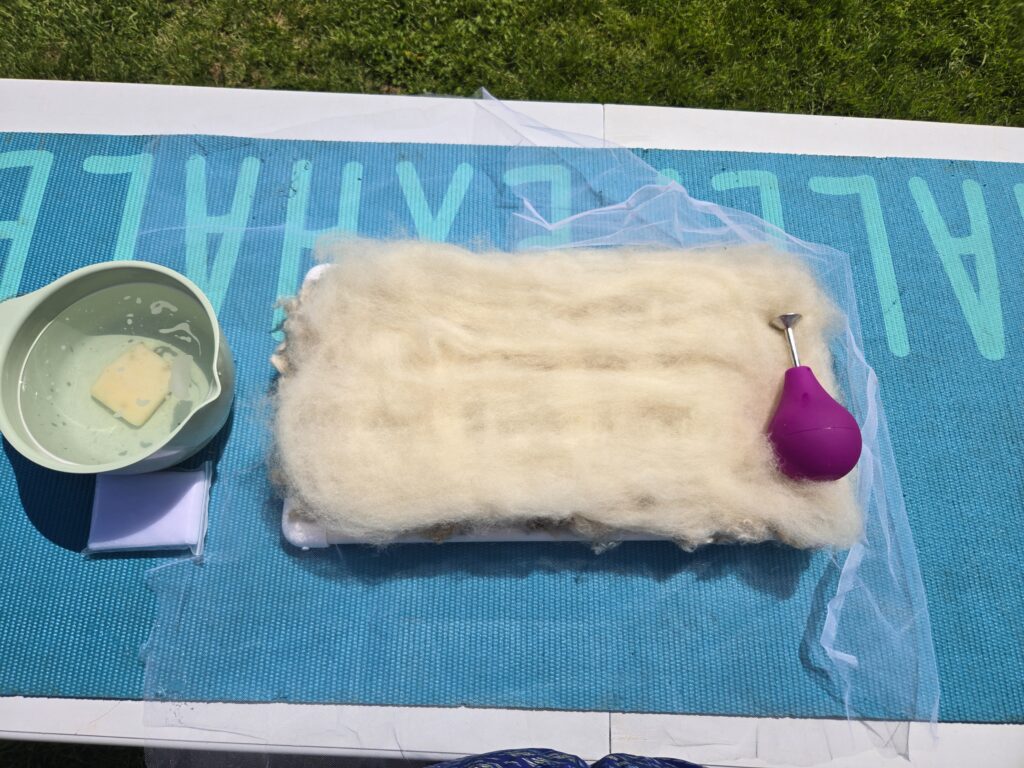
- Now, cover the roving with the felting mesh. You can see in the picture above that I have a piece of mesh under the project as well, but that is not necessary.
- Begin wetting all the fiber down with a bulb sprinkler. It will take quite a bit of water to thoroughly wet all the layers.
- Gently rub the bar of soap on the mesh until foam begins to form.
- Then, very gently, begin rubbing the roving through the mesh with your fingertips to start pre-felting the fiber. You don’t want to be too aggressive right now because it will cause the fiber to move out of place.
- Continue gently rubbing the rug inside the frame for about 30 minutes. Make sure you give the same attention to all parts of the rug so that it becomes felted in all areas.
- After 30 minutes have elapsed, continue rubbing, but with more pressure now. Add more soap and water as needed to create suds that allow your hands to glide over the rug. The extra water should come out the sides of the frame. It is normal for the water to look dirty if you are using raw locks!
- Rub with more pressure for 30 minutes then check your progress by removing the mesh and doing a pinch test. The fibers should be noticeably felted and stick to one another when you try to lift any section.
- With the mesh gone, continue rubbing the rug in all directions for 30 minutes. You can remove the frame at this time as well. Make sure you rub the edges so that they become fully felted.
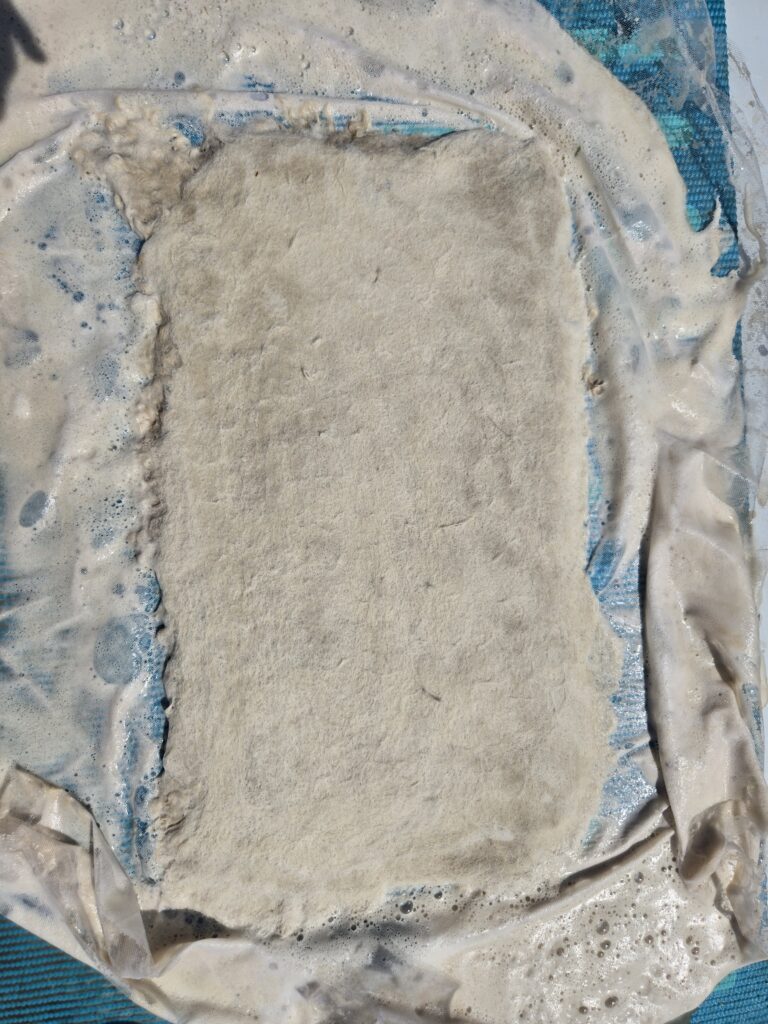
- Now your rug should be ready for the rolling phase. Take your dowel and roll your rug into a log with the dowel in the center. Roll the log back and forth 100 times (one back and forth motion counts as one roll).
- Unroll the log and turn the rug 90 degrees, roll it back up and roll 100 times.
- Continue this process until you have turned the rug 360 degrees.
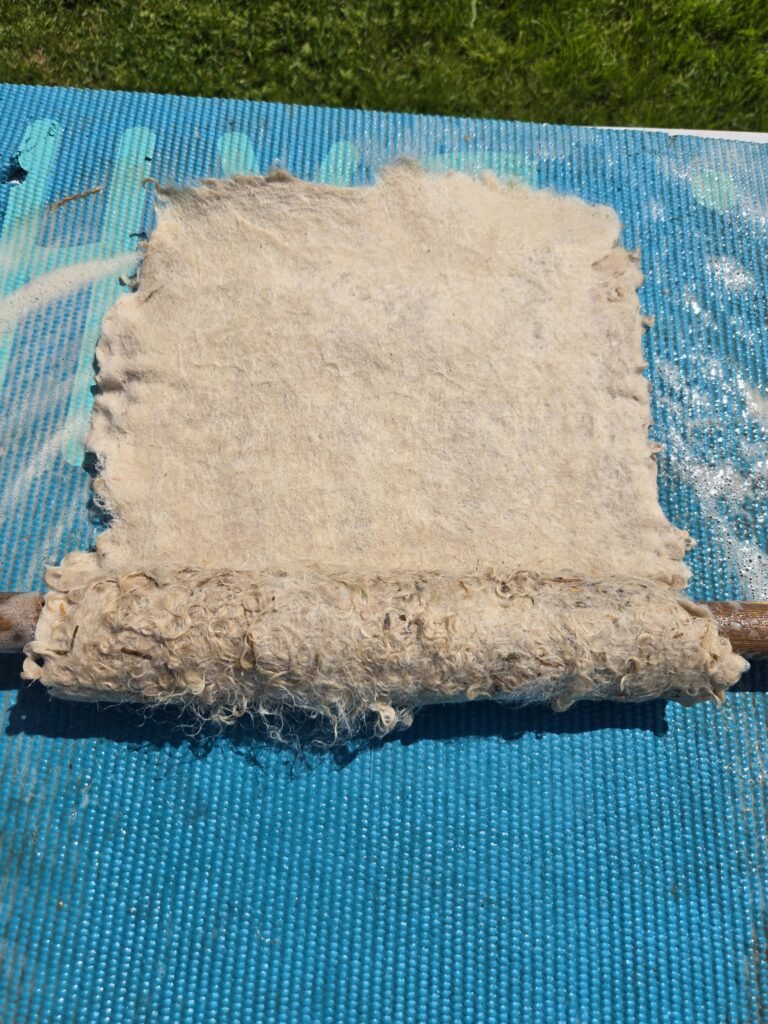
- Now flip the rug over to the lock side and roll it up again. Do 100 rolls, turning the rug 90 degrees each time. Now you should have completed 800 rolls.
- Examine your rug, it should be looking pretty good but will benefit from more rolling. Flip it so that the backing is facing up and roll it in the dowel again 100 times, turning the rug 90 degrees each time.
- Flip it once more to the lock side and roll it up and complete 100 rolls, turning the rug 90 degrees each time. Now you should have completed a total of 1600 rolls.
- Take a final look at your work and check for any places that seem to need more felting. Rub or roll as necessary.
- Now you are ready for the final step in felting, throwing the rug on the ground! I throw my rug on my concrete patio about 100 times, turning it different ways when I throw it.
- You did it! Now your rug is ready to be rinsed. Rinse all the soap from the rug with cold water. Add a little bit of Power Scour to help clean it and make it smell fresh. Rinse the Power Scour out and then wring the rug out as best you can.
- Now the rug needs to dry. This may take a few days depending on how thick it is and where you place it. The sun and a good breeze really help with drying.
- Once the rug is dry, you can inspect it and gently brush the locks if you want your rug to have a fluffy texture.
- If there are any areas that are bare or matted, you can add more locks by needle felting them into place. All you need to do is take washed locks that match and stab them in repeatedly with a felting needle where you want them.
- Enjoy your felted fleece rug!