How to Make a Wet-Felted Bowl

You can use fiber to create a decorative 3D vessel to hold things. Here are the directions to make a wet-felted bowl with mohair, soap, and your hands. Step-by-step instructions, an equipment list, and recommendations are provided.
This post contains affiliate links. As an Amazon Associate, I earn from qualifying purchases.
Wet felting is so much fun! As an Angora goat breeder, I am always looking for new ways to use my mohair. Along with making felted soap and dryer balls (follow the links for those tutorials), I have created 3D vessels with fiber to hold things for my farmer’s market display.
I love functional art and these mohair bowls are decorative, sturdy, and showcase the strength and beauty of my goats’ locks.
Here is how you can make a wet-felted bowl with natural fiber, soap, and lots of elbow grease!
Fiber to Use to Make a Wet-Felted Bowl
You will want to use natural animal fiber like wool, alpaca, or mohair to create a wet-felted bowl, synthetics will not felt. I use mohair because I raise Angora goats and have lots of it, but it is rather slippery and doesn’t felt as readily as wool.
If this is your first felting project, I would stick with wool until you have a good feel for the felting process.
You can use roving, combed top, or a batt of fiber to make a wet-felted bowl. You will pull small wisps of fiber off and layer them on a resist or form to create your vessel. Your fiber should be already washed or scoured and processed so that the fibers are separated.
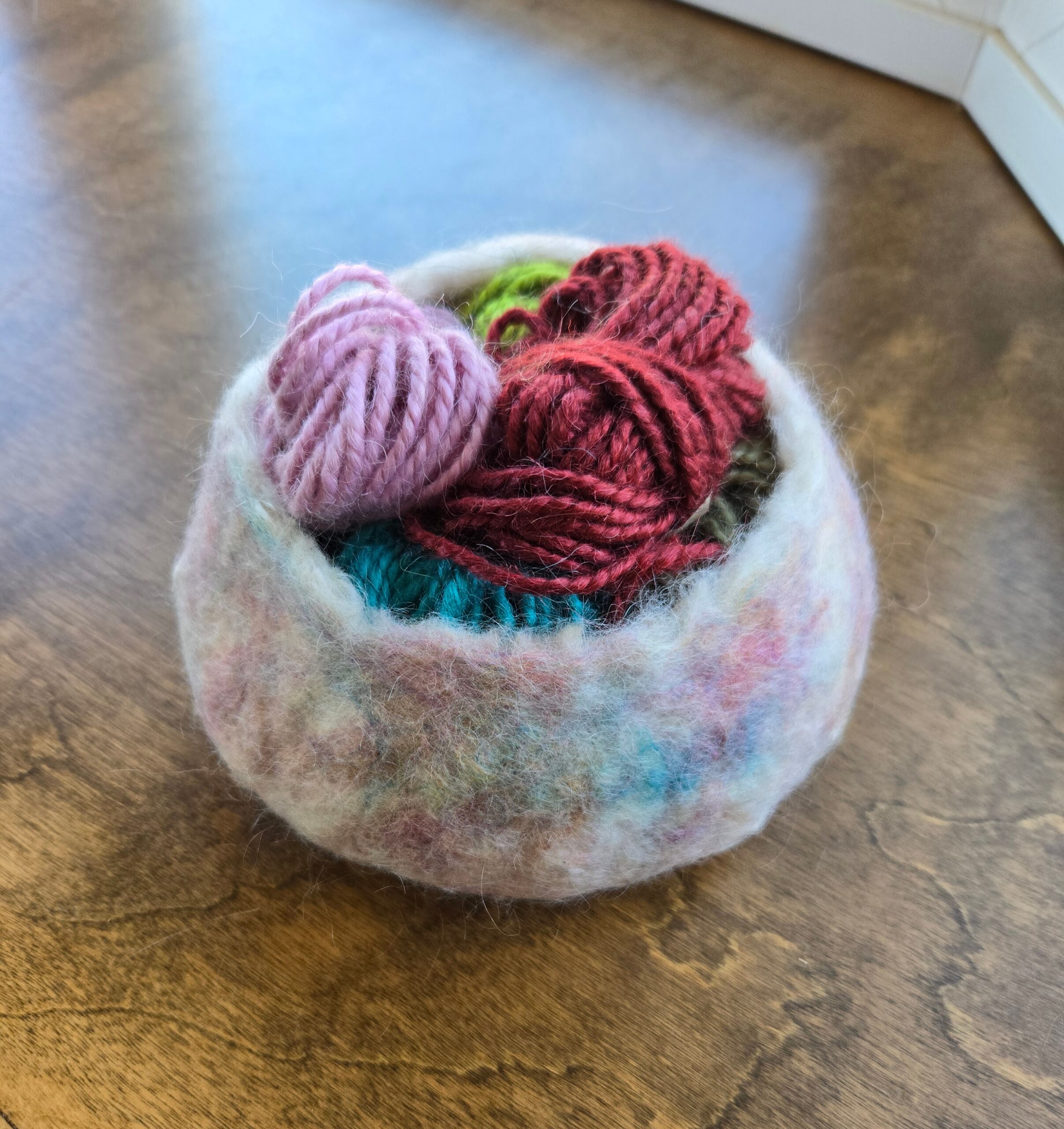
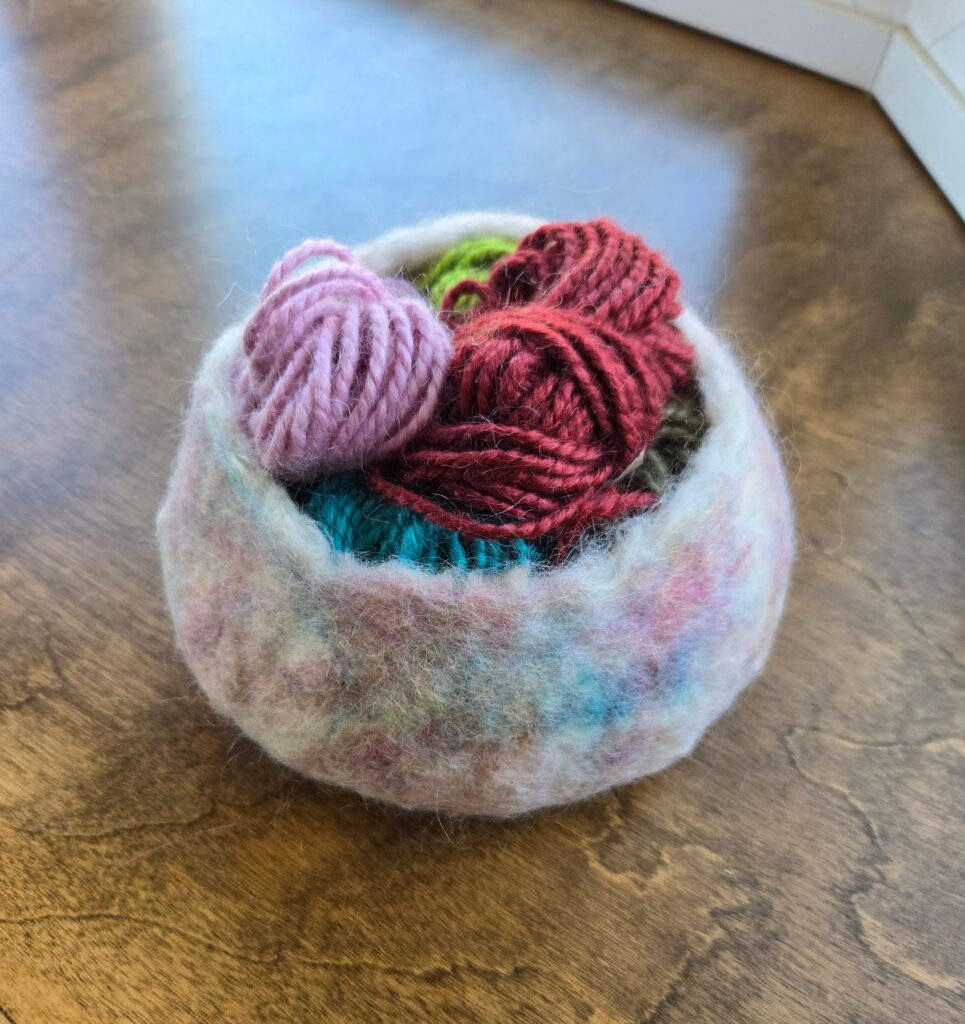
You can use natural colored fiber or dyed fibers to make the bowl look however you desire. I used white mohair for my bowl and decorated the outside with wisps of colored wool.
Felting Techniques Used to Make a Wet-Felted Bowl
The process of wet felting involves using water, soap, and agitation to create a dense fabric from thin layers of natural fiber. It is essential that you work slowly and methodically for your vessel to turn out symmetrical and strong. This project will take several hours, so plan accordingly.
To create a hollow shape like a bowl, you will use a resist or flexible barrier between the layers of fiber to prevent them from sticking together during the felting process. It will be removed before the final shaping of the item.
After layering your fiber over the resist, you will use soap and water to begin felting. Gently massaging the fiber with your hands on a textured surface like bubble wrap is how you will get the fibers to begin to bind to one another.
Once the bowl has reached the pre-felt stage, you will use a towel and dowel to roll the item hundreds of times to make sure it is fully felted and shrinks to the appropriate size.
The last steps are to full, rinse, and shape your vessel and then allow it to dry. Let’s get started!
Equipment Needed to Make a Wet-Felted Bowl
- 2 ounces of mohair or wool (to make the vessel)
- Colored fiber, silk, or other fiber embellishments (for decoration)
- Kitchen scale
- Foam floor underlayment (to make the resist)
- Scissors
- Bubble wrap
- Saran or other plastic wrap
- Water
- Soap
- Dowel
- Towel
I used two ounces of mohair to make a bowl that has a diameter of about 6 inches when finished. If you want to make a smaller or larger vessel, adjust the amount of fiber accordingly. If you want the outside of the bowl to be decorated, you can use additional fiber as embellishments.
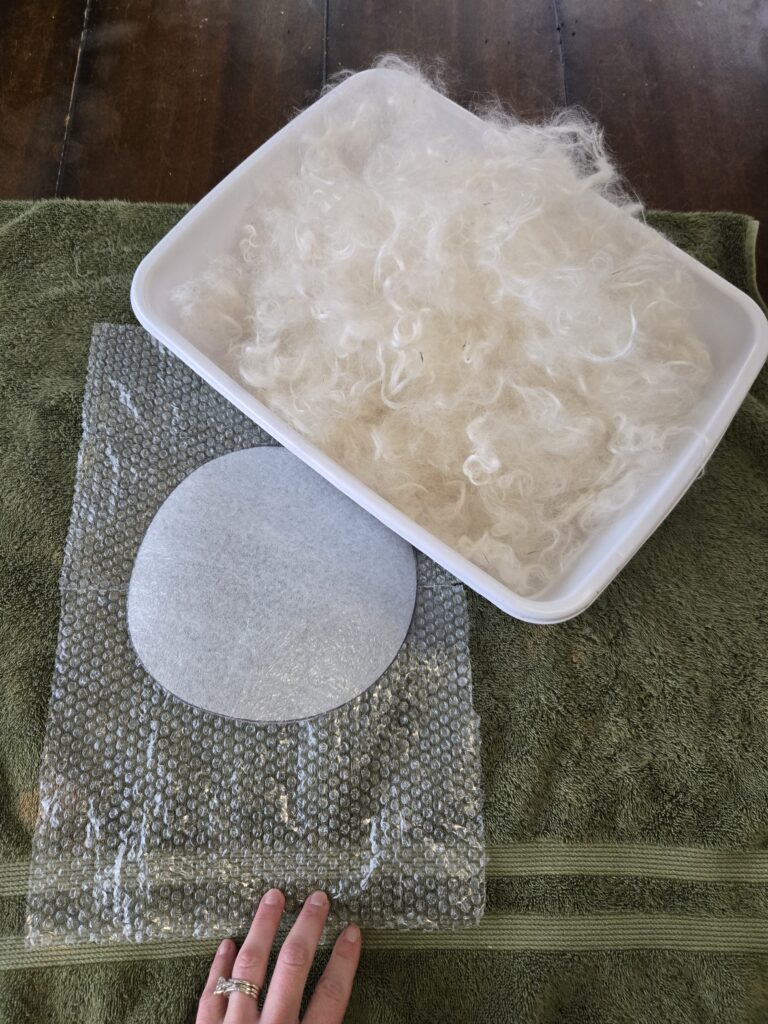
Use a kitchen scale to weigh your fiber and a piece of foam floor underlayment to make the resist. I used a soup bowl with an 8-inch diameter as a template for my resist. Scissors will be used to cut out the resist and remove it from the felted vessel. Small, sharp scissors will be easiest to use.
You will need two pieces of bubble wrap for the project. They just need to be bigger than your resist. Saran or plastic wrap will help you felt the fiber more easily without moving it around too much. Cut your plastic wrap to the same size as your bubble wrap.
I use hot water because it speeds up the felting process. A spray bottle or bulb sprinkler is helpful for wetting down your felting project. If you don’t have one that’s ok too. Just use your hands to transfer a little bit of water at a time from a bowl.
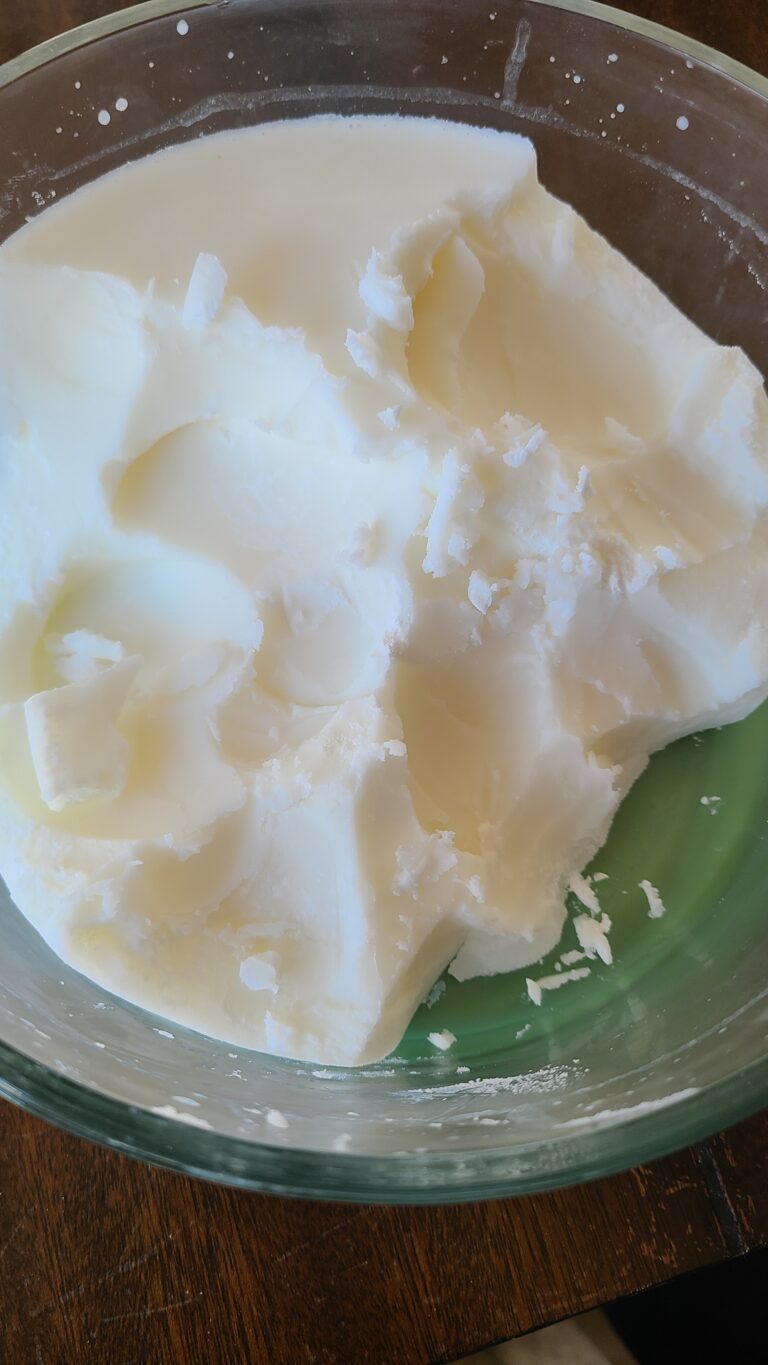
I use my homemade goat milk soap, which is olive oil based, for wet felting, but Dawn dish soap works great too!
A dowel makes it easier to exert more pressure on the project to finish the felting process. It also gives you a nice round shape for rolling.
Wrapping your project in a bath towel gives you a soft surface to work with and will soak up any soapy water that gets squeezed out, a win/win!
Now that we understand what we are going to do and have all the supplies ready, let’s get to work!
Directions to Make a Wet-Felted Bowl
- Set out all your supplies on a large, flat workspace. I make wet-felted bowls at my kitchen table, it’s not super messy.
- Using a kitchen scale, weigh out 2 ounces of fiber for the project. Separate it into four piles of ½ ounce each.
- Create the resist. Trace the shape that you want onto a piece of foam floor underlayment and cut it out with scissors. I used a soup bowl with an 8-inch diameter as my resist template.
- Fold a bath towel in half and put it where you want to do your felting.
- Lay one piece of bubble wrap (bubble side up) on top of the towel.
- Lay a piece of plastic wrap on top of the bubble wrap.
- Lay your resist on top of the plastic wrap.
- Use one ½-ounce pile of fiber and begin covering the resist with the first of four layers of fiber to make the inner part of the vessel. Pull off thin wisps and layer them halfway over one another. Start about one inch beyond the edge of the resist and continue inward toward the center. Make sure the resist is completely covered and that the layer is even.
- Make a second layer. This time arrange the wisps from left to right, so they are aligned horizontally. Make sure the resist is completely covered and that the layer is even.
- Make the third layer. This time arrange the wisps up and down, so they are aligned vertically. Make sure the resist is completely covered and that the layer is even.
- Make the fourth layer. This time start at the center of the resist and shingle the wisps in an outward direction until they hang about an inch off the resist.
- Now, we have a thoroughly cross-hatched fiber pattern that will felt. Wet it down with a spray bottle or bulb sprinkler and add some soap. Don’t soak it too much, just wet it enough so that the fiber lays against the resist.
- Place another piece of plastic wrap over the wet fiber and carefully flip the project over so that you see the other side of the resist.
- Remove the plastic wrap to expose the resist and fold the wisps of fiber that are hanging off the edges around the resist so that you cannot see the margin.
- Using a second ½-ounce pile of fiber, repeat the process of making four layers on side 2 of the resist. Align the fibers just how you did on side 1.
- Wet this side down, add soap, and flip the resist over again.
- Now the inside of the vessel will be complete. If you want to make the outside a different color than the inside, use 1 ounce of colored fiber for the inside and another for the outside.
- Fold the wisps hanging off the edges around the resist.
- Now we will make the outside of the bowl. Using a third ½-ounce pile of fiber, repeat the process of making four layers on side 1 of the project. Align the fibers just how you did in the beginning.
- Wet them down and then decorate with fiber embellishments, if you so desire. I used colored wool to make the outside of my bowl colorful.
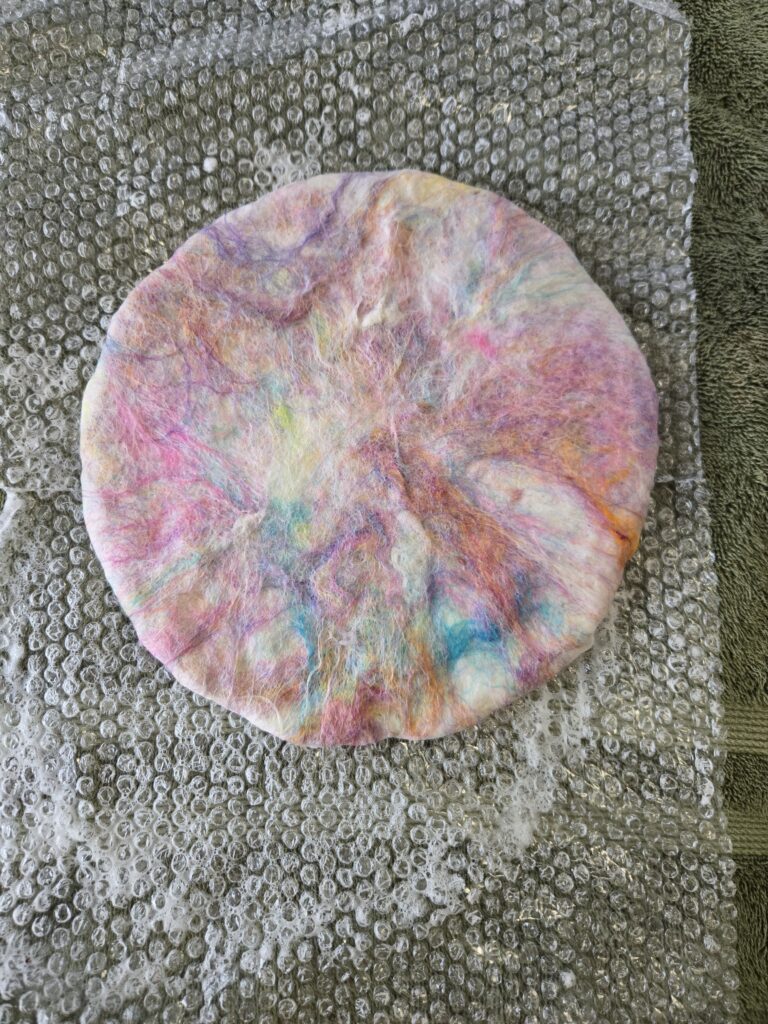
- Flip the project over, fold the protruding wisps over the edges and then repeat the process for side 2.
- Using the last ½-ounce pile of fiber, repeat the process of making four layers on side 2 of the project. Align the fibers just as you have been doing.
- Wet the fibers down and then decorate to make your design.
- Flip the project back to side 1 and fold the last wisps over the edges.
- Now, we are ready to start felting! Cover your project with a piece of plastic wrap and make sure your bubble wrap is underneath.
- Using your fingertips on the plastic wrap, gently massage the entire project for 15 minutes. Don’t use too much pressure or you will move your embellishments. Make sure you rub the edges of the resist and give adequate attention to each area.
- At the end of the 15 minutes, remove the plastic wrap and check for felting. The fibers should be beginning to stick to one another and not lift up.
- Now, flip the project over and massage side 2 for another 15 minutes. If you need to add more soap or water go ahead. It should be foamy and wet, but not leaking out everywhere. Keep the towel underneath to catch any drips.
- Check your felting progress on side 2.
- Now it is time to roll! Put a piece of bubble wrap (bubbles up) under your project with side 1 facing you, put another piece of bubble wrap on top (bubbles down). Put the dowel in the middle.
- Roll your towel, with the dowel, project, and two pieces of bubble wrap into a long sausage.
- Gently rock the sausage back and forth 100 times (one back and forth movement counts as one time)
- Unroll and give the project a quarter turn, then rock it another 100 times.
- Repeat this process until you have turned the item back where it started. 400 rolls should be completed.
- Now unroll and flip your project to side 2. Roll it back up and complete 400 rolls on this side. Turn the project a quarter turn every 100 rolls.
- Now flip it back to side 1 and do another 400 rolls, but with more pressure this time. Don’t forget to unroll and turn the project a quarter turn every 100 rolls.
- Do the same thing on side 2.
- Now you should have completed 1,600 rolls and the project should be well felted and the shrinkage should be making the resist begin to curl up.
- It is time to remove the resist. Where you remove the resist is where the opening of your bowl will be. Decide how big you want it and where. I used a canning jar lid as a template for my hole.
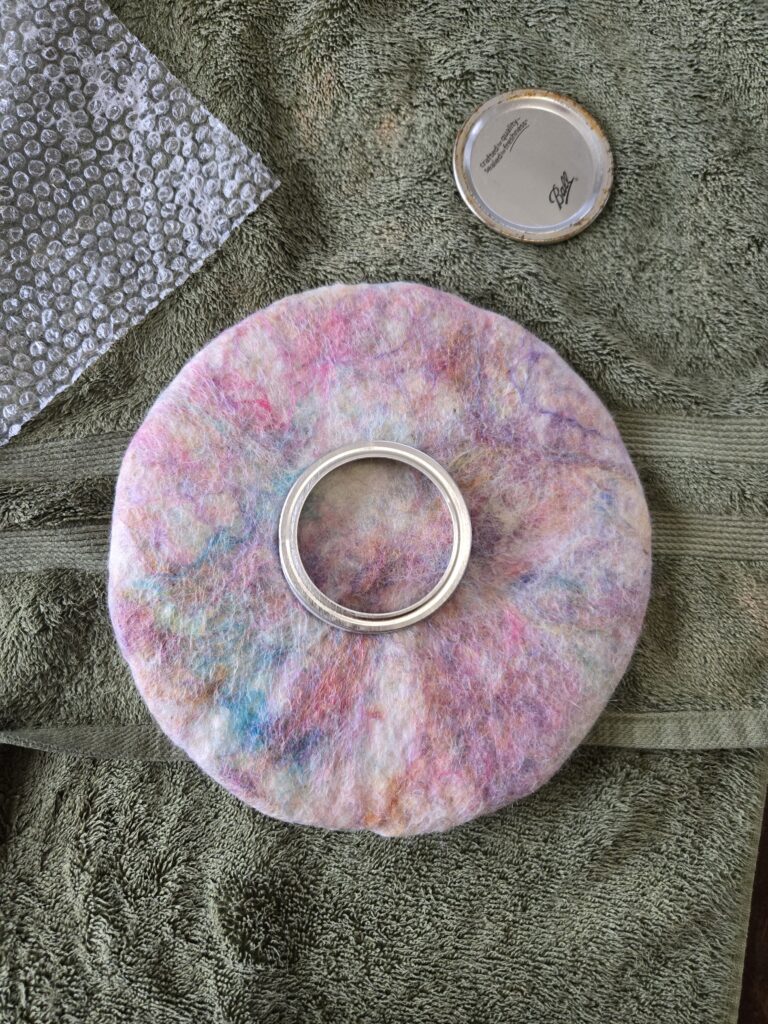
- Using a pair of small, sharp scissors cut your bowl opening hole to expose the resist.
- Now, you will want to “heal” the edges of the hole so they aren’t shaggy. Using soapy water, gently massage the edges of the fiber to felt them. This will take 5-10 minutes.
- Once the hole has been healed, you can grab the resist and pull it out.
- To help the bowl shrink and become fully felted, now you can roll it up from one edge and continue rocking it. I roll it 50 times, then fold it at another location and roll another 50 times until I have completed 200 rolls on side 1.
- Do the same thing on side 2 of the project.
- Now you can begin shaping your bowl with your hands. You will want to work on getting rid of the crease and flat areas from when your project was two dimensional.
- To help with final shrinkage and to remove the soap, rinse your bowl in plenty of cold water at the sink.
- Now, you can do the final shaping of your bowl. I packed my bowl with clean hand towels to hold the shape that I wanted. You can use a blown-up balloon, ball, or other object to help form your bowl.
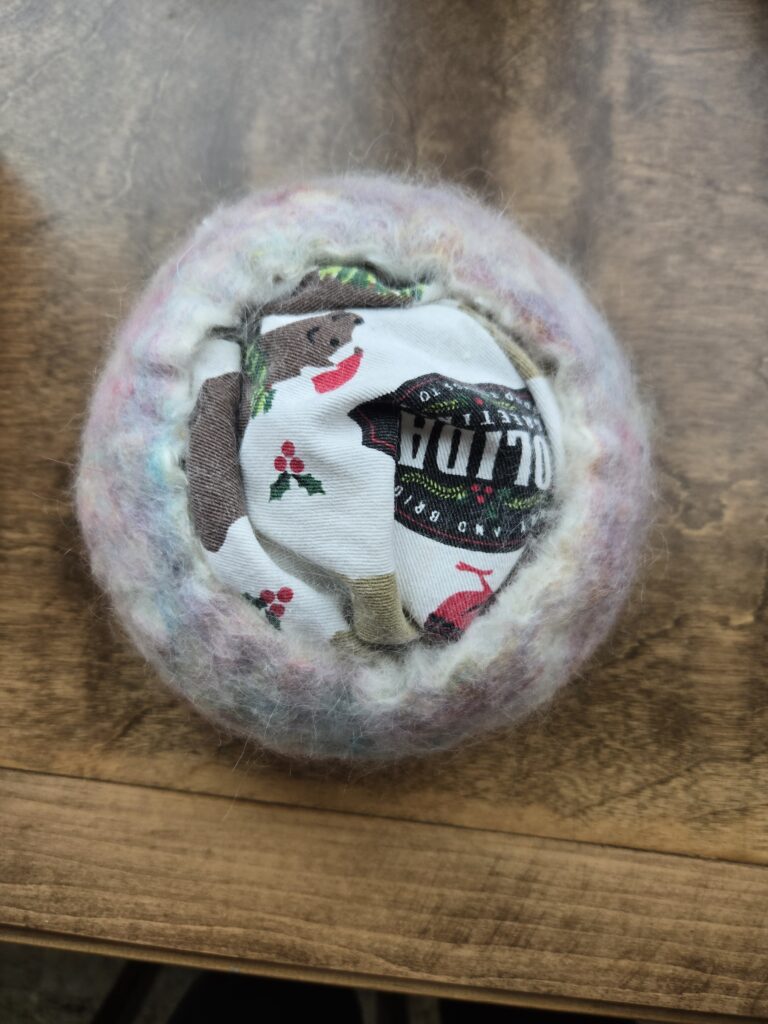
- Now your wet-felted bowl just needs to air dry for a few days. I put mine in my bay window while drying.
- After it is completely dry, you can unpack your bowl. If you want, you can iron the outside of the bowl to remove any wrinkles. Use the wool setting on your iron and moist heat.
- Use your wet-felted bowl to hold your favorite items!