How to Smoke a Whole Goat Leg: Pulled Goat Meat Recipe

Here is our recipe and cooking directions for making tender, juicy, and flavorful pulled goat meat. Directions for preparing a homemade rub, smoking, and braising a whole goat leg are provided. Use it to make tacos or over rice in a protein bowl!
This post contains affiliate links. As an Amazon Associate, I earn from qualifying purchases.
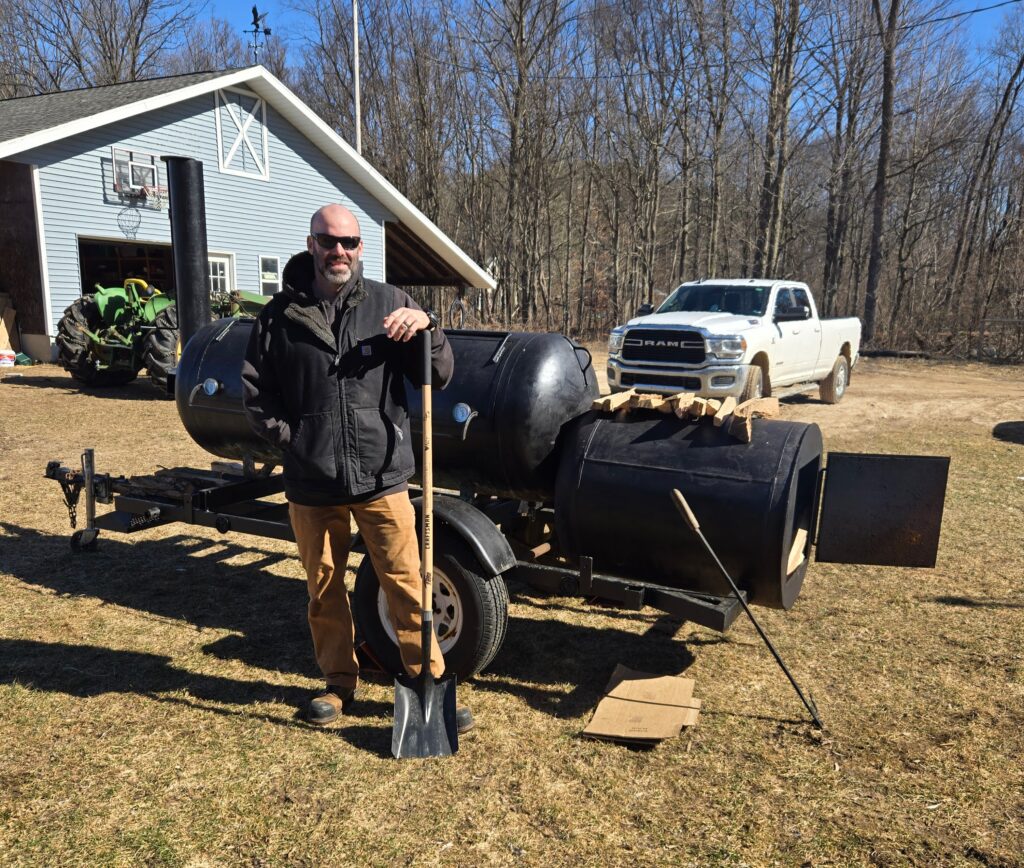
I recently built a traditional offset smoker out of old propane tanks and a trailer. I have been testing it out making ribs, whole chickens, cheese, and pork burnt ends. Everything has turned out amazing, so I decided to pull out one of the goat legs I had been saving in our freezer and make that.
Smoking more popular meats like pork and chicken is easy because there are countless recipes and cook directions that you can find to follow. Preparing goat meat, on the other hand, is still pretty much uncharted territory. Although goat is one of the most consumed red meats in the world, Americans haven’t quite caught on and it can be a challenge to find tips for cooking it .
Much of what our family eats is goat meat, as that is the predominant livestock that we raise. If you haven’t tried it, you’re missing out! Goat meat is a delicious, healthy protein option with a rich, savory flavor. It’s great for roasting, searing, grilling, and smoking. Anything you could do with beef, you can do with goat meat. For more on goat meat, click here to read our other article.
One of our goals for our farm is to educate the public on the health benefits of goat meat and encourage people to try it. So, here’s a killer recipe and cooking tips for a whole smoked goat leg that you can pull to make the best tacos you’ve tasted!
Why Use a Smoker?
Lean meats like goat are best prepared slowly. Smoking and braising this goat leg created tender, juicy meat that pulled with ease. The prolonged cooking time and impact of the smoke resulted in rich, complex flavors that complemented the natural taste of the goat meat.
Smoking is a fun way to prepare food in a primitive fashion, with flavors you can’t get in any other way!
Materials Needed for Smoking a Whole Goat Leg
- Whole goat leg (3-4 lbs)
- Dry rub
- Olive oil
- Mortar and pestle
- Mixing bowl
- Measuring cups and spoons
- Boning knife
- Cutting board
- Nitrile gloves
- Smoker
- Spray bottle with mixture of water and apple cider vinegar
- Meat thermometer
- Aluminum pan
- Aluminum foil
- Beef stock
- Minced garlic
- Oranges
- Yellow onion
We used a homemade juniper berry rub with sugar, salt, and spices to make a paste with olive oil to create a crust to lock in the moisture of our goat leg during smoking. Braising the leg in an aluminum pan with garlic, onion, and citrus at the end of the cook helped caramelize the bark and ensure tender, juicy pulled goat meat. Follow the steps below to rub, smoke, braise, and pull your goat leg to perfection.
Preparing the Rub
First, go ahead and make your rub. Add juniper berries, thyme, rosemary, and oregano to a mortar and use the pestle to crush and blend these coarse spices to release their flavor. Then, transfer the mixture to a bowl and add the sugar, salt, and other spices. Find detailed instructions and the recipe for our juniper berry rub here.
This rub is great on a lot of things. I love it on pork as well. It makes plenty, so use it for your smoked goat leg and store the rest in an empty spice container.
To make this a wet rub for smoking, add enough olive oil to the dry rub to make a paste (it shouldn’t be runny). Put it to the side as you will need it shortly.
Preparing the Goat Meat
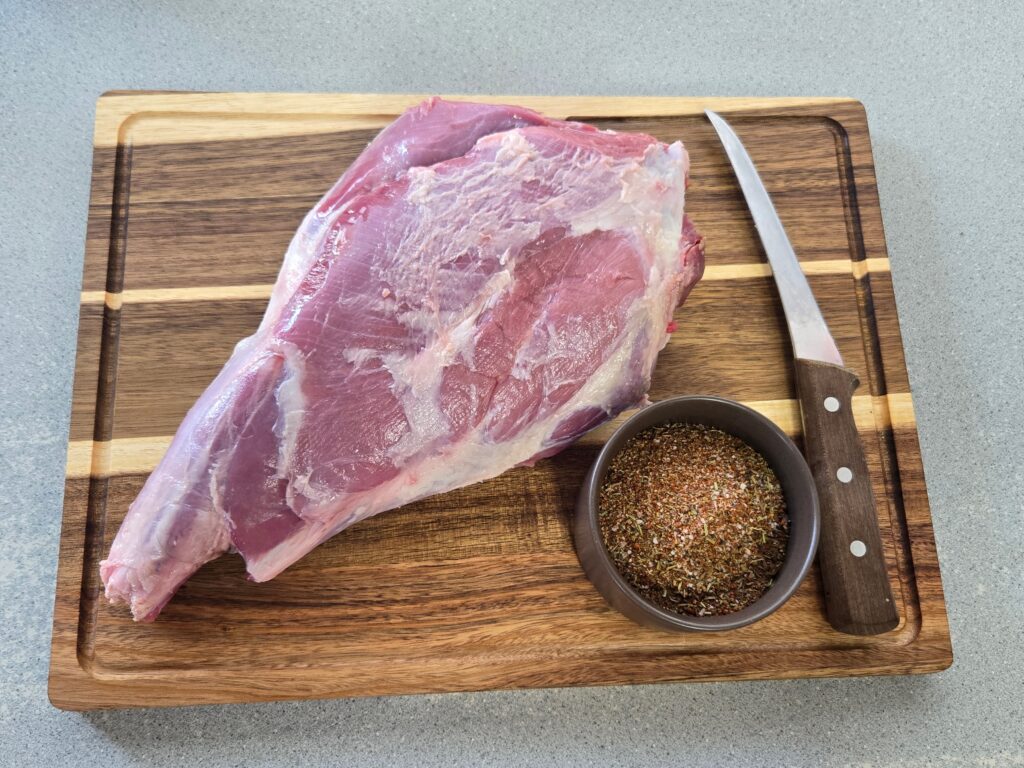
Now, turn your attention to the goat leg. It should be thawed out and at room temperature. Although goat meat can be pretty lean, there may still be some scraps of fat. Go ahead and trim those bits off, along with some of the thick membrane or silver skin that may be on top. Removing this will help the rub penetrate the meat better and bring those flavors in your rub to the meat.
Lay the goat leg on a clean cutting board and throw on some nitrile gloves if you have them. No problem if you don’t, just make sure you wash your hands. Rub the meat generously with the paste you made in the previous step. Rub to coat the meat on all sides and both ends. Make sure you hit everywhere.
Once rubbed, take a sharp knife and poke the leg all over. Stuff a little bit of the rub mixture in as many of these holes as you can to help the rub get into the meat a bit more than just the surface.
To help the rub set and allow time for the salt to absorb and redistribute juices throughout the meat, place the leg on a tray and refrigerate, uncovered, for 12-24 hours.
Smoking the Meat
Now, its time to cook! Fire your smoker up and get it running at 250 degrees. Once its humming along at temperature, insert a thermometer and throw that leg on the cooker. As much as you may want to, don’t open the cooker door for the first two hours. Let the meat soak up that smoke and keep your temps controlled with a steady supply of wood and smoke. I use a combination of apple and oak wood in my smoker.
At the two hour mark, its time to start spritzing the meat. For the liquid in the spray bottle, I recommend apple cider vinegar and water. You can use just water, apple juice, or anything you want. It just has to be wet. The reason to spray the meat has to do with how the meat cooks. The outside is exposed to all the heat. However, the inside takes time to cook. It can be difficult to cook a large piece of meat all the way through without completely crisping the outside. The goal here is to keep the outside moist. As the moisture on the outside evaporates, it also will provide a cooling effect to the surface. You want to mist the meat, not create puddles on the surface. Apply just enough to keep it slightly wet. It’s the same concept as when your body sweats when you get hot. So every 30 minutes or so, mist the outside of the meat on all sides.
Over the course of the cook, and as you continue to spritz the meat, you will notice it change color from red, to golden brown, to almost black. This is normal. This is the bark that all barbecue enthusiasts look for when smoking meat. You are aiming for the meat to reach an internal temperature of 155-165 degrees Fahrenheit. Every piece of meat is different but for me, this took about five hours.
You will notice the meat “stall” around the three hour mark. This is when the temperature stops going up, and can even go down. Don’t panic! This is normal. Remember that cooling effect I talked about with the misting? Within the meat, the moisture is constantly going to the surface, and evaporating out. As the meat is starting to “sweat” more and more, the evaporative cooling goes into overdrive and can stall the temperature for a long time. The stall is usually around this 145 degree mark.
Braising the Meat
Braising the goat leg helps it cook a bit faster, but also keeps what moisture is left to ensure you don’t end up with a dry and chewy dinner. After smoking for five hours, our leg was braised for three hours, for a total cook time of eight hours.
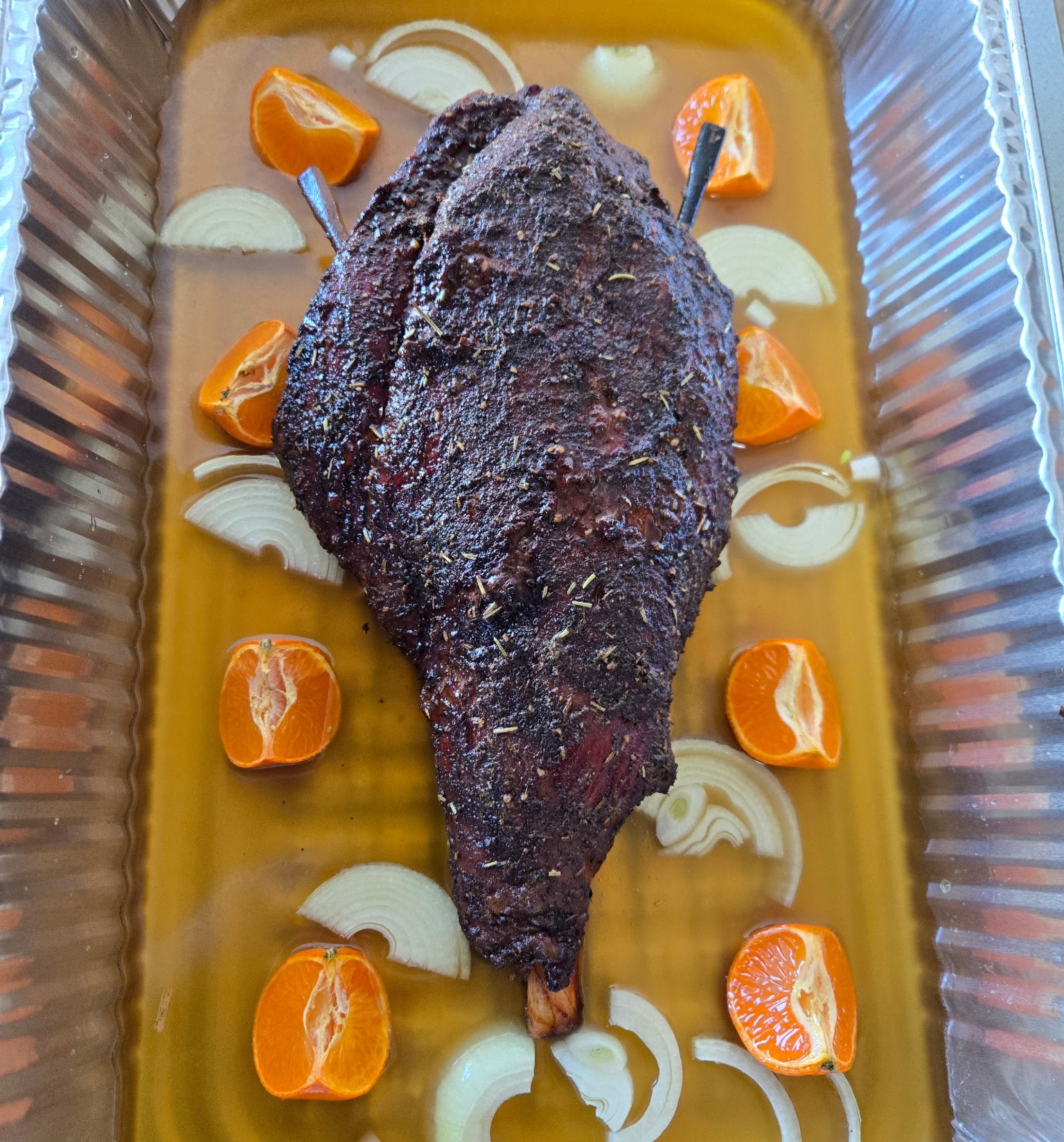
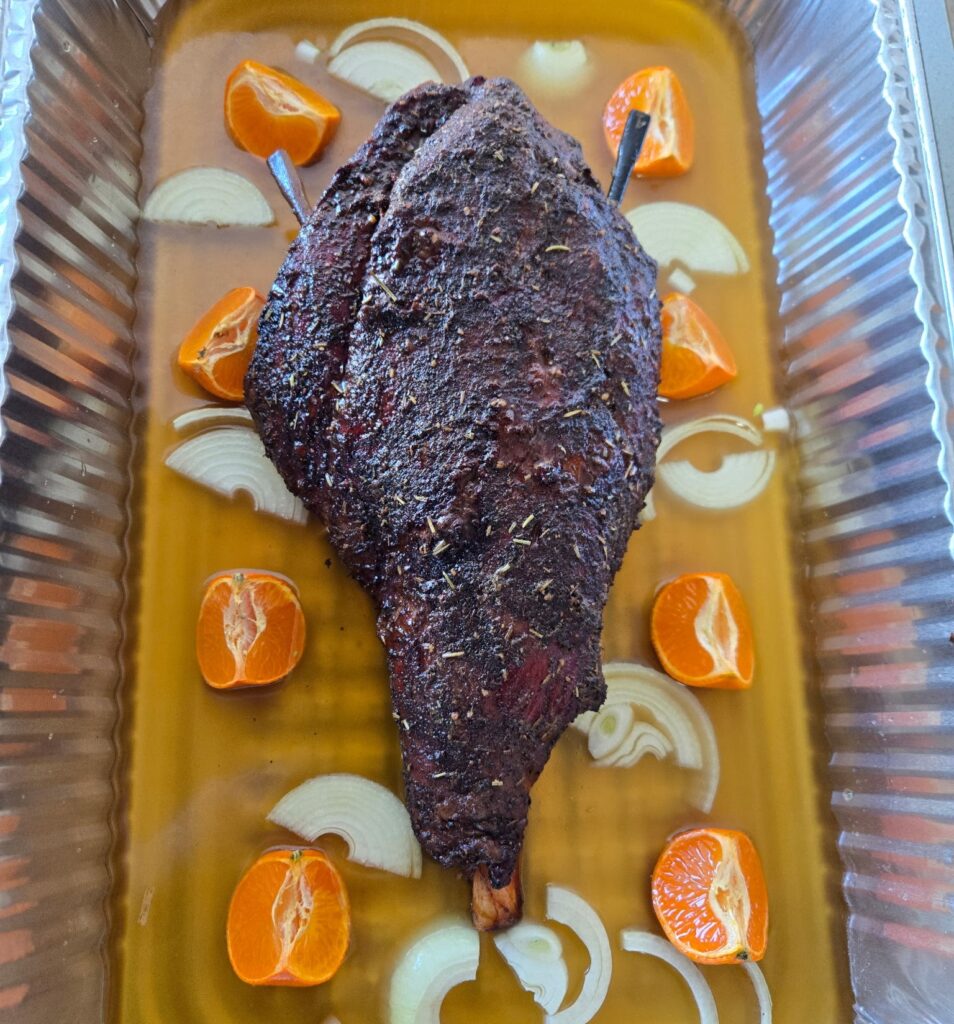
To braise, pull the leg off the smoker once it hits 160 degrees, and place it in your aluminum pan. Add beef stock to the pan with the leg until it reaches about a half inch up the sides. Add some thickly sliced onions, minced garlic, and halved oranges to the pan as well. See pictures of our smoked leg in the braising pan at the top of this post.
Cover the pan tightly with aluminum foil and place it back in the smoker. At this point, you could also just throw it in the oven as the meat will obviously no longer take any smoke being in a covered pan. Just out of principle, I like throwing it back on the smoker. Don’t be afraid at this point to raise the temp to 275 to help push the meat along a bit faster.
Continue to monitor your temperature. The end goal is an internal temp of about 200-205 degrees. This will result in tender goat meat that pulls readily.
Resting and Pulling the Meat
Once the meat hits your target temp, pull the pan out of your smoker (or oven), and set it on the counter to rest. Resting for around 30 minutes allows the moisture to redistribute throughout the meat and prevents it from running all over once you cut into it.
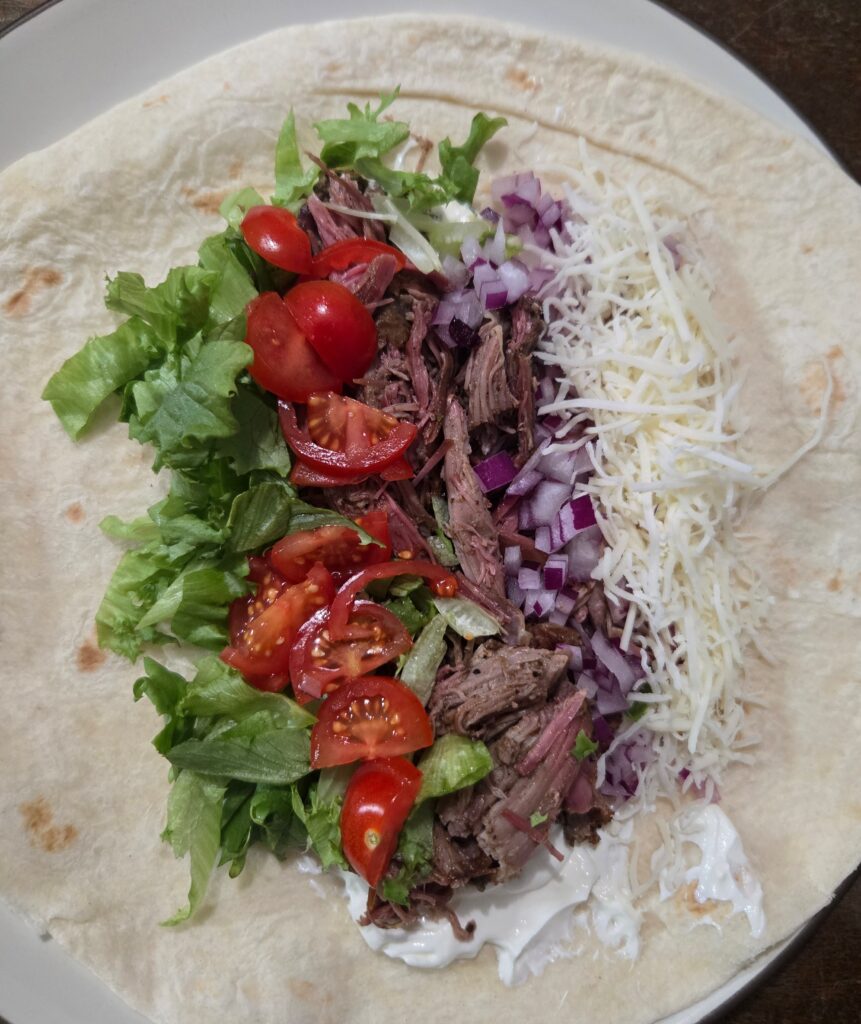
We opted to pull our goat leg and make tacos. You can use two forks or meat claws to divide the meat along the grain and shred it. Don’t forget to mix in the bark for smoky flavor and texture!
The following day, we used the leftovers to add to protein bowls with rice, cheese and vegetables. So good!
Hungry for more goat meat recipes? Check out how to make goat belly rouladen, ground goat tacos, or seared goat loin medallions using the links provided!