How to Complete an Inspection on a Newborn Goat Kid: 12 Item Health Checklist

Right after birth, you should conduct a health screening on each of your baby goats. It only takes a few minutes and can allow you to identify and respond to potential issues as soon as possible. Use this checklist to give your newborn goat kids a thorough, whole-body assessment.
This post contains affiliate links. As an Amazon Associate, I earn from qualifying purchases.
Congratulations on your new arrivals!
Those baby goats that you have been waiting for are finally here. You and your doe got through labor and now it may seem like a whirlwind of tasks getting kids dried off and latched onto a bottle or mom.
Amongst the chaos, don’t forget to complete a quick health screening on each of the baby goats. It only takes a moment or two and can allow you to identify and respond to potential issues as soon as possible.
Here is the checklist that I use to give each newborn kid a thorough once-over and whole-body assessment.
1. Check the Newborn Goat’s Eyes
The first thing that I look at when examining a newborn goat is her eyes. The eyes should be clear and alert. If it was a difficult birth, some swelling of the face is normal. The eyes may be a little puffy, but this will go away quickly.
Another thing that I look for when inspecting the eyes is signs of entropion. Entropion is genetic and more common in the Boer breed of goat. Entropion occurs when the eyelids are rolled inward, toward the eyeball. This causes the eyelashes to rub on the eye resulting in pain, redness, tearing, squinting, cloudiness, and ulceration of the cornea. If left untreated, it can cause permanent blindness.
Minor cases of entropion can be corrected by gently rolling the kid’s eyelids out with your hands. This should be done multiple times a day along with applying a lubricating ointment. More severe cases may require injections of penicillin or sterile water into the eyelid to keep the eyelashes out of contact with the eye. Contact your veterinarian for recommendations on dealing with entropion in your goats.
2. Check the Newborn Goat’s Nose
The newborn goat should have a clear nose, without drainage. Goats breathe through their nostrils. Make sure both sides are clear of mucus from birth and that the kid is breathing normally without making any rattling noises.
A bulb syringe can be used to expel mucus from the nose. Squeeze the bulb, gently insert the tip into the nostril, and then release. The suction will draw out any liquid.
3. Check the Newborn Goat’s Mouth
At birth, baby goats should have at least one pair of lower incisors present. Goats have a hard pad on the roof of their mouth and no upper front teeth. If your newborn doesn’t have any teeth present, it could be a sign that they are premature.
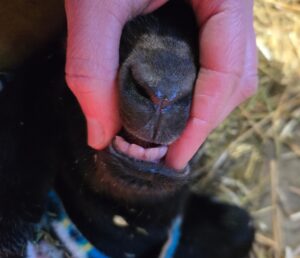
While examining the mouth, also check the kid’s jaw alignment. The upper and lower jaws should meet evenly. Parrot mouth occurs when the lower jaw is undershot or too short. Monkey mouth occurs when the lower jaw is overshot or too long. Both of these conditions are genetic and can negatively impact how well the kid is able to eat. Kids with parrot or monkey mouth should not be used as breeding animals in the future.
Take a look and feel inside the kid’s mouth too. Goats can be born with a cleft palate. You will know if a cleft palate is present if there is a hole in the roof of the mouth extending into the nasal cavity. Kids with a cleft palate will have difficulty nursing and are at high risk of developing pneumonia. Consult with your veterinarian if you think your newborn has a cleft palate.
Lastly, check for a sucking reflex with your finger while inspecting your goat’s mouth. Premature kids may lack the sucking reflex and may need to be fed via a stomach tube until it develops.
4. Check the Newborn Goat’s Ears
Make sure your newborn goat’s ears are nice and dry so they don’t lose precious body heat. If they are wet, dry them using a towel or hair dryer.
Goats will have breed specific ears. Some breeds like Boer, Nubian, and Savannah have long, pendulous ears that can be folded vertically or horizontally at birth. If folds are present, they usually go away over time and no intervention is needed.
Many breeds of goats have erect or pointed ears and the LaMancha breed is considered naturally “earless.” LaMancha goats do have ears, they are just very small. LaManchas with “elf ears” will have some cartilage that extends from the head, while those with “gopher ears” appear to have no external ear.
5. Check the Newborn Goat’s Legs
The kid’s legs are the next thing that I check. They should be mostly straight and the newborn should be trying to stand on them within minutes of birth. It’s normal for the legs to be a little wobbly at first and not completely straight. After being cramped up in the womb and pushed through the birth canal, it may take a few hours for them to gain stability.
If your kid’s legs are a little contracted, helping support their weight as they practice standing and a gentle massage can help. If your kid’s front legs are knuckled over, this could be a sign of a selenium/ Vitamin E deficiency. Before providing any treatment like splinting or BoSe, please contact your veterinarian for advice.
A newborn goat’s hooves are soft and gel-covered at birth. The hooves quickly harden up as they begin walking around.
6. Check the Newborn Goat’s Umbilical Cord
After you have checked all of the legs, take a look at your newborn goat’s umbilical cord. Many does trim the umbilical cord while cleaning the kid off after birth. If the stump is long enough to get stepped on or dirty, you can cut it shorter with a pair of clean scissors.
To prevent infection, the umbilical cord should be dipped in iodine. The entire stump, up to the belly, should be saturated for at least 15 seconds to kill the bacteria that cause joint ill. I keep iodine in my kidding kit. For more information on stocking a kidding kit, click here to read my other article.
7. Check the Newborn Goat’s Anus
Next, check for the presence of an anus under the tail. Lacking an anal opening, a condition referred to as atresia ani, is a rare, but serious condition with a poor prognosis. Without a complete digestive tract, the kid will not be able to survive. Euthanasia is usually performed by a veterinarian in these cases.
8. Check the Newborn Goat’s Genitals
Of course, you want to know if your goat kid is a boy or a girl. You can examine the genitals to determine the animal’s sex and if he or she has any abnormalities.
Male kids, or bucklings, will have a prepuce on their belly, behind the umbilical cord. They will also have a scrotum between their hind legs. At the time of birth, both testicles should be able to be felt in the scrotum.
The absence of one or more testicles in the scrotum indicates cryptorchidism. This fairly common hereditary condition occurs when one or both testicles remain in the abdomen. Wethering (castrating) a cryptorchid goat requires surgical intervention by a veterinarian. If left intact, the cryptorchid male goat will exhibit buck behaviors but reduced fertility. It is not advisable to use a cryptorchid goat for breeding purposes as this condition is a developmental anomaly and can be passed on.
Female kids, or doelings, will have a vulva below their anus. It is normal for the vulva to be a little swollen after birth from the hormones of the dam.
9. Check the Newborn Goat’s Teats
Both male and female goat kids have teats. You can count teats to determine whether your newborn kid meets breed standards. If you plan on showing or breeding your buckling or doeling in the future, this is something to note.
Dairy breeds of goats like the Nubian, LaMancha, and Nigerian Dwarf should have only two teats. On the other hand, extra teats are allowed for Boers, with some exceptions. See your breed association website for information on acceptable teat structure and disqualifications.
10. Check the Newborn Goat’s Poll
You can feel the poll (the top of your goat’s head) to give you some early clues as to whether they will develop horns or not. A polled (naturally hornless) goat’s head will have smooth, moveable skin, while solid “horn buds” can often be felt at birth in a goat that is not polled. Horn buds become more pronounced within the first week of life.
At this time, you can decide whether to let your goat grow horns or have them disbudded. Click here to learn about reasons to keep goats with horns. For information on using a disbudding iron on goat kids, click here to read my other article.
Some breeders select for polled genetics, but it is important to know that two polled goats should not be bred to one another. It can result in hermaphroditism in offspring and other congenital abnormalities.
11. Check the Newborn Goat’s Weight
Birth weights for baby goats can vary significantly. The heaviest kids are often slightly overdue, singletons, or born to overweight does. In contrast, the lightest kids are most likely multiples or born shy of 150 days gestation. Either way, what’s important is that the kid grows at a steady rate.
Using a scale to get a baseline weight on your newborn kid can help you gauge their growth over time. A healthy kid should have a good appetite and double their birth weight by the time they are two weeks old.
12. Check the Newborn Goat’s Temperature
It is imperative that a newborn goat stays warm. The normal body temperature for a goat is 102 to 103 degrees Fahrenheit. A cold kid will be weak, lethargic, and sleepy, while a warm kid will be alert, active, and interesting in nursing.
A hypothermic kid, with a temperature below 100 degrees, should never be fed cold. If you find your goat showing symptoms of being chilled, don’t give them a bottle. Put them on a heating pad or float them in warm water (isolate them in a plastic bag so they don’t get wet) to bring their temperature up first.
You should use a rectal thermometer to accurately take a baby goat’s temperature. If you don’t have one, feeling inside their mouth can give you a little clue as to how warm they are. If their mouth is cold, that is a sign that they are hypothermic.
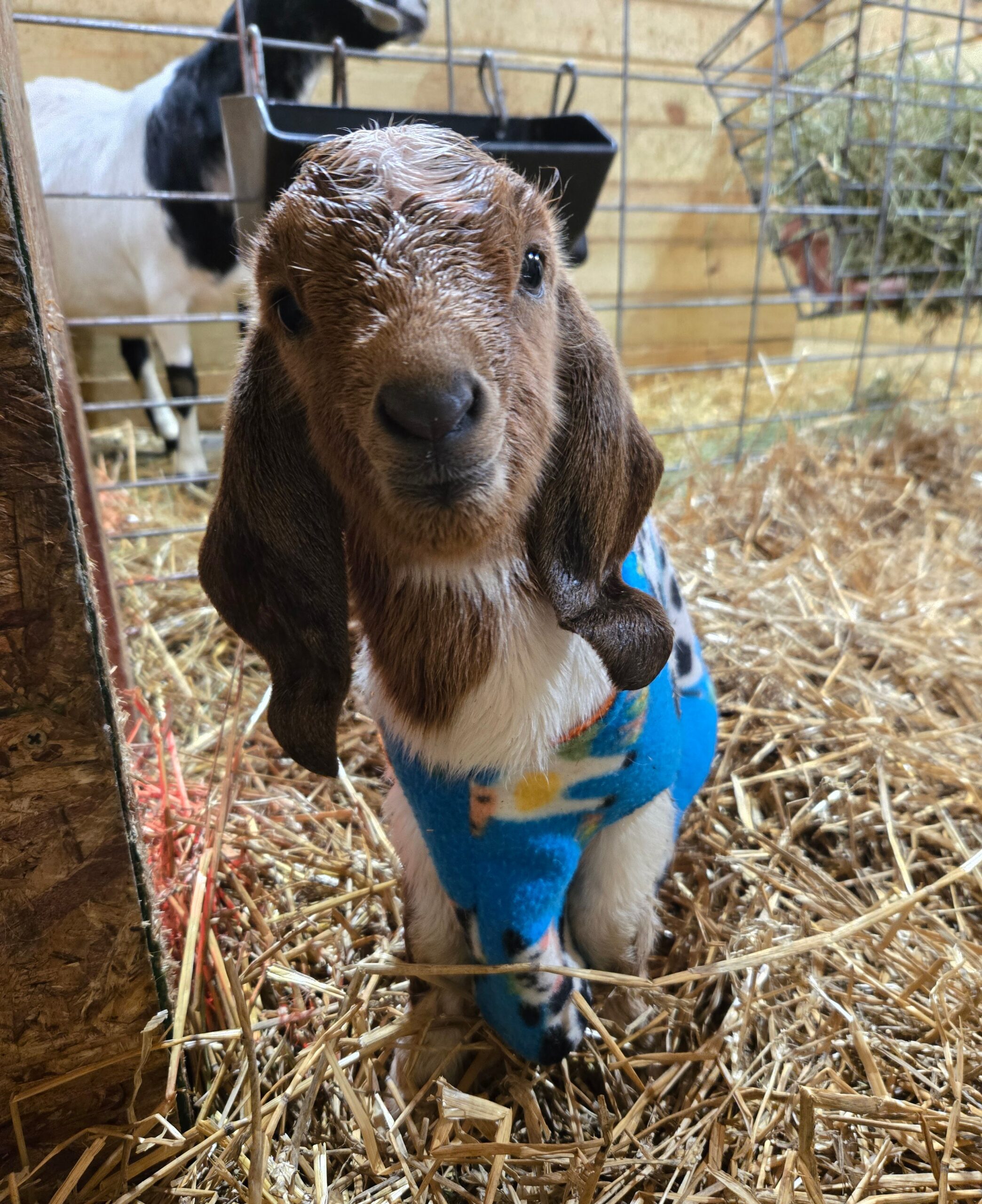
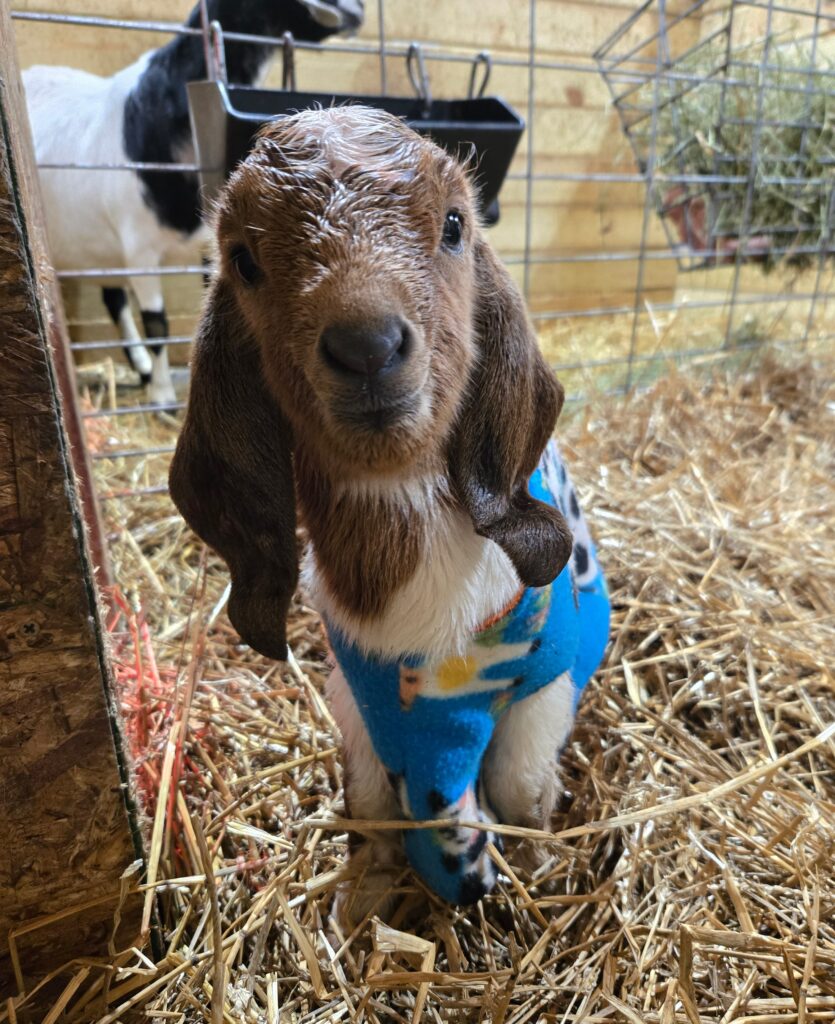
Since we kid in the winter in Michigan, we use warming barrels in our kidding pens to help kids maintain their body temperature. For more information on building and using a warming barrel, click here to read my other article. We also put coats on all our babies for the first week. For directions to make a no-sew baby goat coat from an old sweatshirt, click here.